The Tale Behind The Tune: “Stargazer” by Rainbow
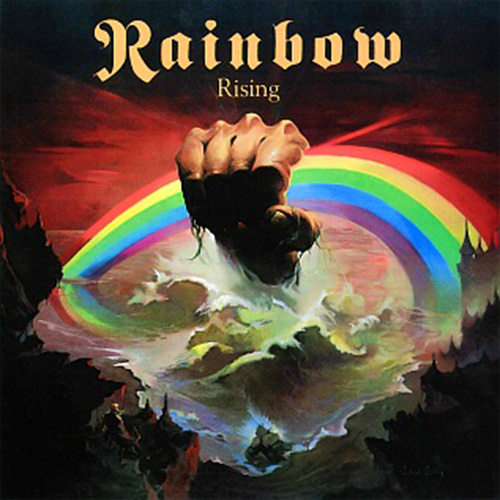
In the mid-1970s, hard rock was stretching beyond familiar blues-based riffs and straightforward anthems. Bands sought scale, atmosphere, and narrative weight. Not many tracks captured that ambition at the time as completely as Rainbow’s “Stargazer,” the towering centerpiece of the 1976 album Rising. Clocking in at more than eight minutes, the song remains a landmark of heavy rock, a sweeping tale of hubris, forced labor, and shattered illusion set to music of matching grandeur.
Rainbow was still a fairly new project when the song took shape. Ritchie Blackmore had left Deep Purple and launched the band with vocalist Ronnie James Dio, initially drawing most of the lineup from Dio’s previous group, Elf. After the debut album, Blackmore retained only Dio and rebuilt the group with drummer Cozy Powell, bassist Jimmy Bain, and keyboardist Tony Carey. Rehearsals for the second record began during the fall of 1975. Unlike the more tightly controlled writing of the first album, Blackmore and Dio encouraged extended jamming. Out of those sessions emerged the material for Rising, including the epic that would define the era.
Blackmore has recalled coming up with the central riff at home. Accounts note that he was experimenting with a cello at the time, an instrument he never fully mastered but that helped generate the song’s distinctive, almost processional feel. The chord progressions and overall structure grew from there. Dio supplied the words and a key melodic idea. Blackmore has specifically credited the singer with the shift into the higher “Where is your star?” section. The result was a true collaboration: Blackmore’s neoclassical and Eastern-tinged guitar language married to Dio’s gift for mythic storytelling.
Dio later explained the narrative clearly. The song is told from the viewpoint of a slave in ancient Egyptian times. A powerful wizard, obsessed with the stars and the dream of flight, forces vast numbers of people to construct a massive tower of stone. The laborers endure heat, rain, whips, and chains. Many die so that the wizard can climb to the top and leap into the sky. When the moment comes, he falls instead of rising. Blood stains the sand. The slaves, suddenly free, are left without purpose until a faint sign of hope appears on the horizon, a rainbow rising. That final image ties the song directly into the album’s closing track, “A Light in the Black,” completing a two-song arc of oppression, collapse, and tentative rebirth.
The story functions as both fantasy and cautionary tale. It warns against false idols and blind devotion while acknowledging the human cost of grand, impossible ambitions. Dio’s lyrics give the music its emotional center, turning what could have been pure spectacle into something darker and more enduring.
Recording took place in February 1976 at Musicland Studios in Munich with producer Martin Birch, a veteran of Blackmore’s Deep Purple years. The sessions were relatively swift. After weeks of rehearsal, many basic tracks were captured in one or two takes, preserving a sense of live energy. Powell’s opening drum passage became one of the song’s most celebrated moments, a thunderous statement that immediately sets the scale. Carey had recorded a keyboard introduction that was ultimately discarded in favor of the drums.
The most ambitious element was the addition of a 28-piece contingent from the Munich Philharmonic Orchestra, conducted by Rainer Pietsch. Blackmore wanted orchestral weight for the song’s climactic section but found the initial arrangements too ornate and busy. The players were asked to simplify repeatedly so that the main riff remained prominent and powerful. As might be expected, frustration mounted among the classical musicians. A gifted gypsy violinist improvised a striking part after the orchestra finished, only for the tape to run out before it could be captured. The lost performance became one of the session’s enduring anecdotes.
Tony Carey layered additional textures with a Vako Orchestron, helping create the song’s exotic, half-Turkish scale atmosphere that Blackmore described. Blackmore’s own extended solo, played in the B Phrygian dominant scale, stands among his finest recorded work. Dio’s vocal performance, tracked later, required multiple takes but delivered the soaring authority the material demanded.
Released in May 1976, Rising and its signature track quickly earned a reputation that has only grown. “Stargazer” is frequently cited as one of the great epics of 1970s hard rock, comparable in ambition to Led Zeppelin’s “Kashmir” yet distinct in its classical and Middle Eastern coloration. Its combination of Powell’s power, Blackmore’s melodic invention, Dio’s theatrical delivery, and the carefully restrained orchestra created something larger than the sum of its parts.
Decades later the song still resonates and has been covered, referenced, and held up as a high-water mark for narrative heavy music. For many listeners it remains the purest expression of the brief but brilliant chemistry between Blackmore and Dio, a moment when rock fully embraced myth, scale, and the darker side of human aspiration. The tower may have fallen, but the music still stands.